Text The medieval episode
Glappo, Steynow and an unnamed castle belong to the thirteenth-century narrative preserved by Dusburg and Jeroschin.
A doubtful name, a real earthwork, a long historical tradition
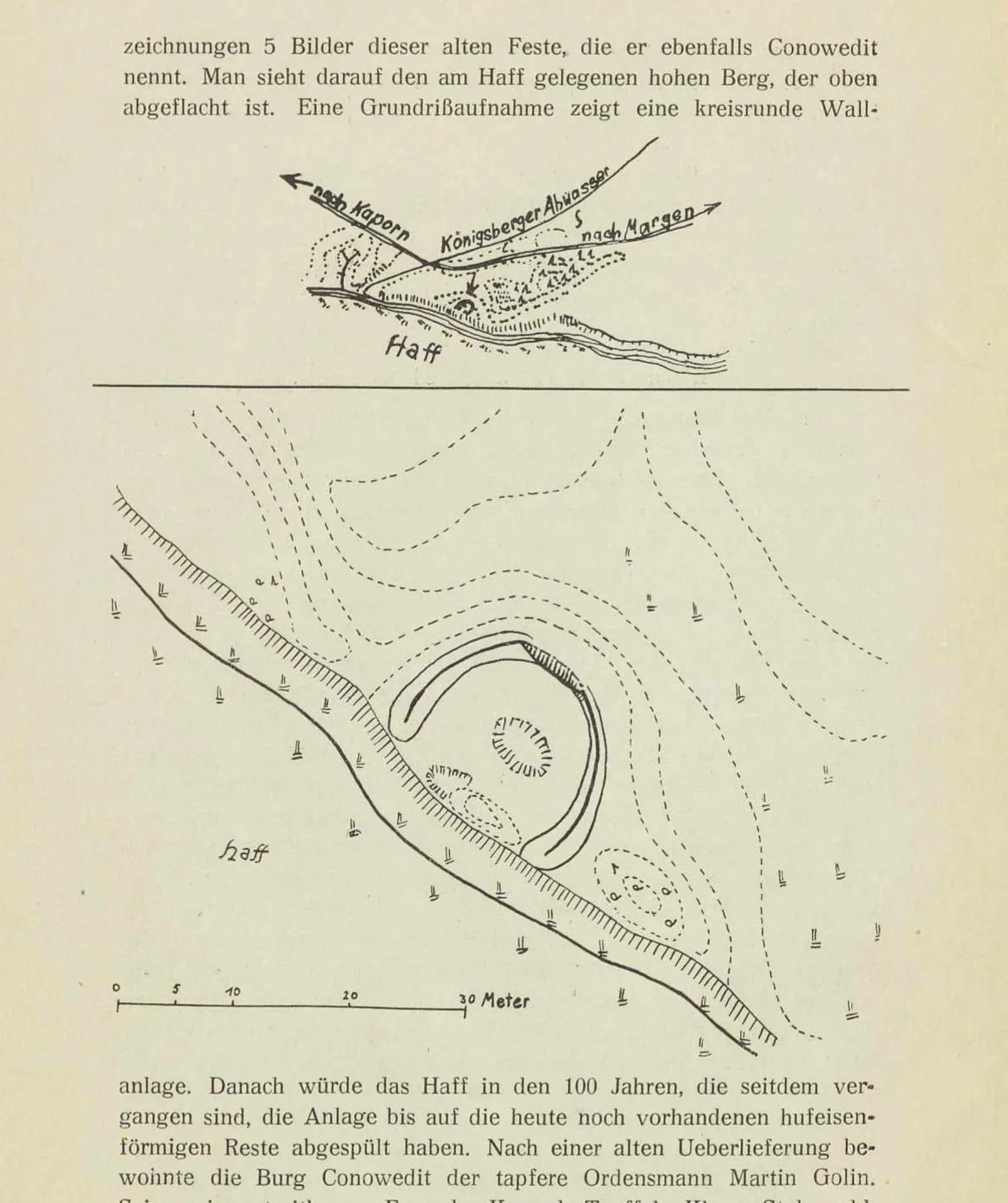
A fortified earthwork once stood on the Haff shore west of Margen, near Caporn. Whether it was the unnamed castle attacked by Glappo in the thirteenth century—and whether its medieval name was truly Connowedit—remains unproved.
The evidence is strongest when its separate strands remain separate: an unnamed medieval castle, a later and unstable place-name, a real coastal earthwork, and a much younger legend joining Martin Golin to the Vierbrüdersäule.
The central conclusion
Glappo, Steynow and an unnamed castle belong to the thirteenth-century narrative preserved by Dusburg and Jeroschin.
A coastal enclosure west of Margen was physically recorded in the nineteenth and twentieth centuries. Its date and builders remain uncertain.
Conowedit, Martin Golin and the Vierbrüdersäule became increasingly entangled in antiquarian and popular retellings.
The site today
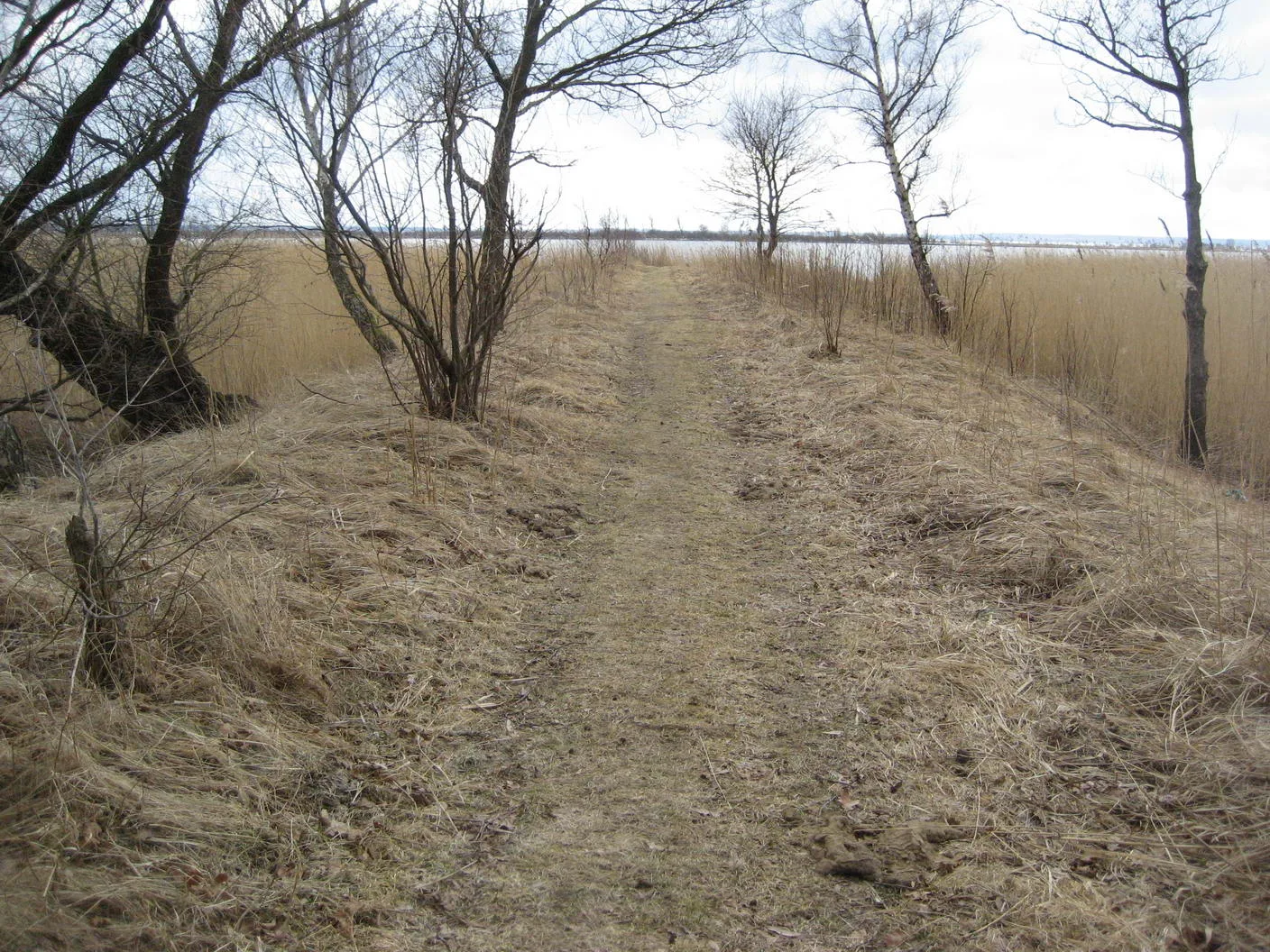
The provisional location is approximately 54.6908° N, 20.3003° E, on the Haff shore west of the former Margen estate. The Russian field report describes an approach through allotments and across the old Königsberg wastewater channel before reaching the banks and shoreline.
The photographs do not by themselves date the earthworks. They are valuable because they place Crome’s abstract plan back into a difficult, overgrown coastal landscape.
Development of the evidence and tradition
Dusburg describes the attack on an unnamed Samland castle, Glappo’s betrayal by Steynow, his capture and execution.
The earliest narrative source used in this investigation.
The castle remains unnamed.
Its Vienna “author’s copy”, produced in direct cooperation with the original author, says that the castle was called Cenauwe. Later witnesses preserve related variant forms.
His wording is cautious: a castle “is said” to have stood in the district.
Martin Galin and two recognisable companions appear, but no Connowedit residence is named.
Their dissertation contains no Golin–Connowedit account.
Connowedit, Golin, four companions, the 1295 ambush and the monument are combined.
Crome later describes five drawings, including a circular ground plan; the originals are now the subject of an archive enquiry.
He argues chiefly from the location near Caporn and opposite Brandenburg.
The Jugend-Album turns Golin’s career and the fall of his companions into an energetic historical romance.
The Margen Schloßberg is documented physically; its historical identification remains traditional.
Photographs and maps reconnect the historical records with the surviving landscape.
Research status
The relevant photographs, provisional coordinate, Russian map crop and modern book references have been examined. Vasiliy has kindly permitted reuse of his 2011 field photographs with a link to the original thread.
Rombert Stapel’s modern edition identifies Vienna Hs. 392 as an “author’s copy”. Its text already gives the castle the name Cenauwe, narrowing the textual problem to where the Utrecht compiler obtained that name.
The Berlin Prussia-Fundarchiv has been asked about the five drawings and Crome’s associated notes. A response can be incorporated as a later research update.
Continue through the dossier
Follow the unnamed castle from Dusburg through the unstable readings of the Younger Hochmeisterchronik, Hennenberger, Voigt, Töppen and Hirsch.
Compare Jester’s topography, Guise and Crome, Messtischblatt states, modern field photographs and the provisional location.
Separate Schütz’s older narrative from Jester’s synthesis, the 1717 silence, the 1853 romance and modern Russian retellings.
Open the annotated bibliography, image credits, research status and publication checklist.