Borrowed or recognisable
Pelusa, the wedding raid, Galin/Golin, Teuffel, Stowemeelen/Stobemehl, seventy dead, captives and booty.
Reception and reconstruction
The legend is not a single inherited tale. It is an accumulation: older raid material, named adventurers, an unidentified manuscript, local topography, a monument and increasingly imaginative retelling.
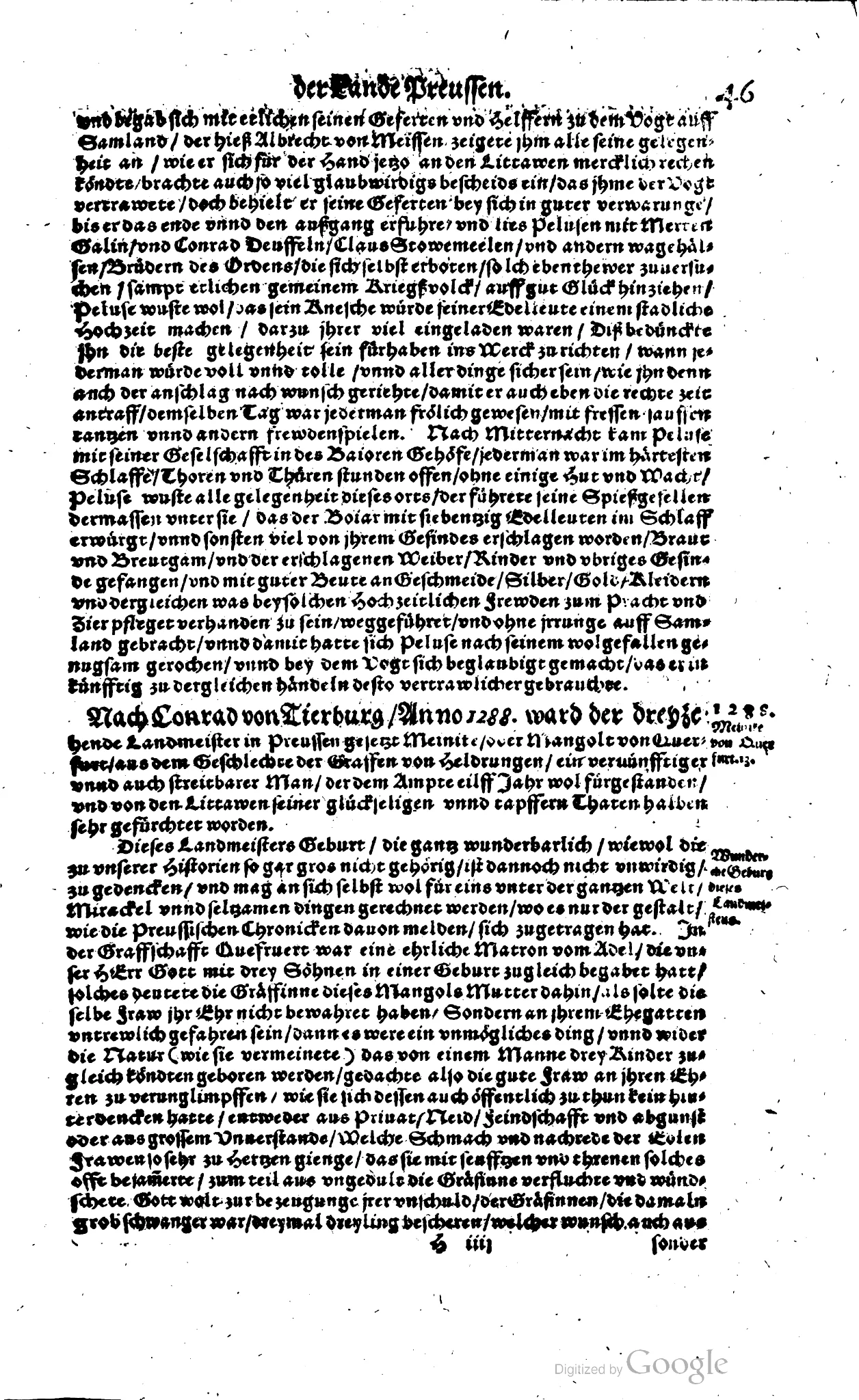
Schütz names Martin Galin, Conrad Deuffeln and Claus Stowemeelen among the Order’s men in the Pelusa wedding raid. His account includes seventy slain nobles, captives and rich booty.
This is clearly related to Jester’s later story. Yet the returning party reaches only Samland; Schütz does not name Connowedit as Golin’s base and does not connect the raid to the Vierbrüdersäule.
| Schütz, 1599 | Jester, 1784 | Assessment |
|---|---|---|
| Martin Galin | Martin Golin | Same figure |
| Conrad Deuffeln | Conrad Teuffel | Direct continuity |
| Claus Stowemeelen | Claus Stobemehl | Probably the same name |
| Other unnamed brothers | Malachias Kobelenz; Balthasar Röder | Additional names need another source |
| Return to Samland | Return to Schloss Connowedit | Connowedit is a later addition |
Johann Christoph Huhn’s dissertation under Johann Jacob Rohde collects numerous learned and popular explanations for the Vierbrüdersäule. It says nothing of Martin Golin, Connowedit, Conrad Teuffel, Claus Stobemehl, Malachias Kobelenz or Balthasar Röder.
Silence cannot prove non-existence. Here it is nevertheless meaningful because the work was deliberately surveying rival explanations of the monument. The complete Golin–Connowedit interpretation was either unavailable to the authors or not yet prominent.
Jester joins the Pelusa narrative to a much fuller story: Golin resides at Connowedit; five companions return there; four are killed in an ambush in 1295; Golin marks their grave; the Landmeister replaces his cross with the Vierbrüdersäule; and Golin later dies after mental decline.
He attributes decisive details to an “old manuscript”, but supplies no author, date, owner, archive, shelfmark, quotation or provenance. It cannot presently be treated as an independently dated medieval source.
Pelusa, the wedding raid, Galin/Golin, Teuffel, Stowemeelen/Stobemehl, seventy dead, captives and booty.
Connowedit as residence, extra companions, the 1295 ambush, grave, monument and Golin’s final fate.
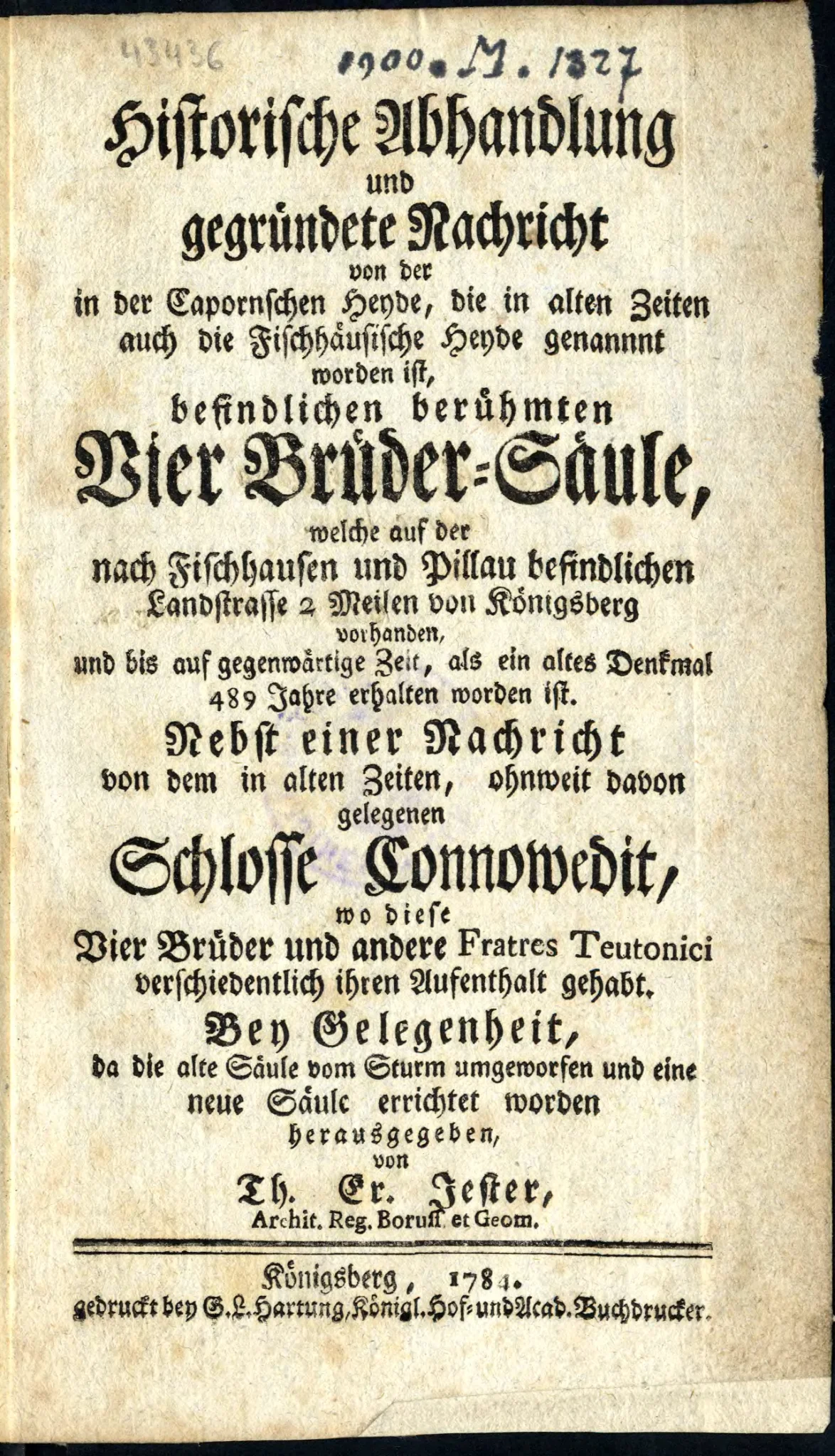
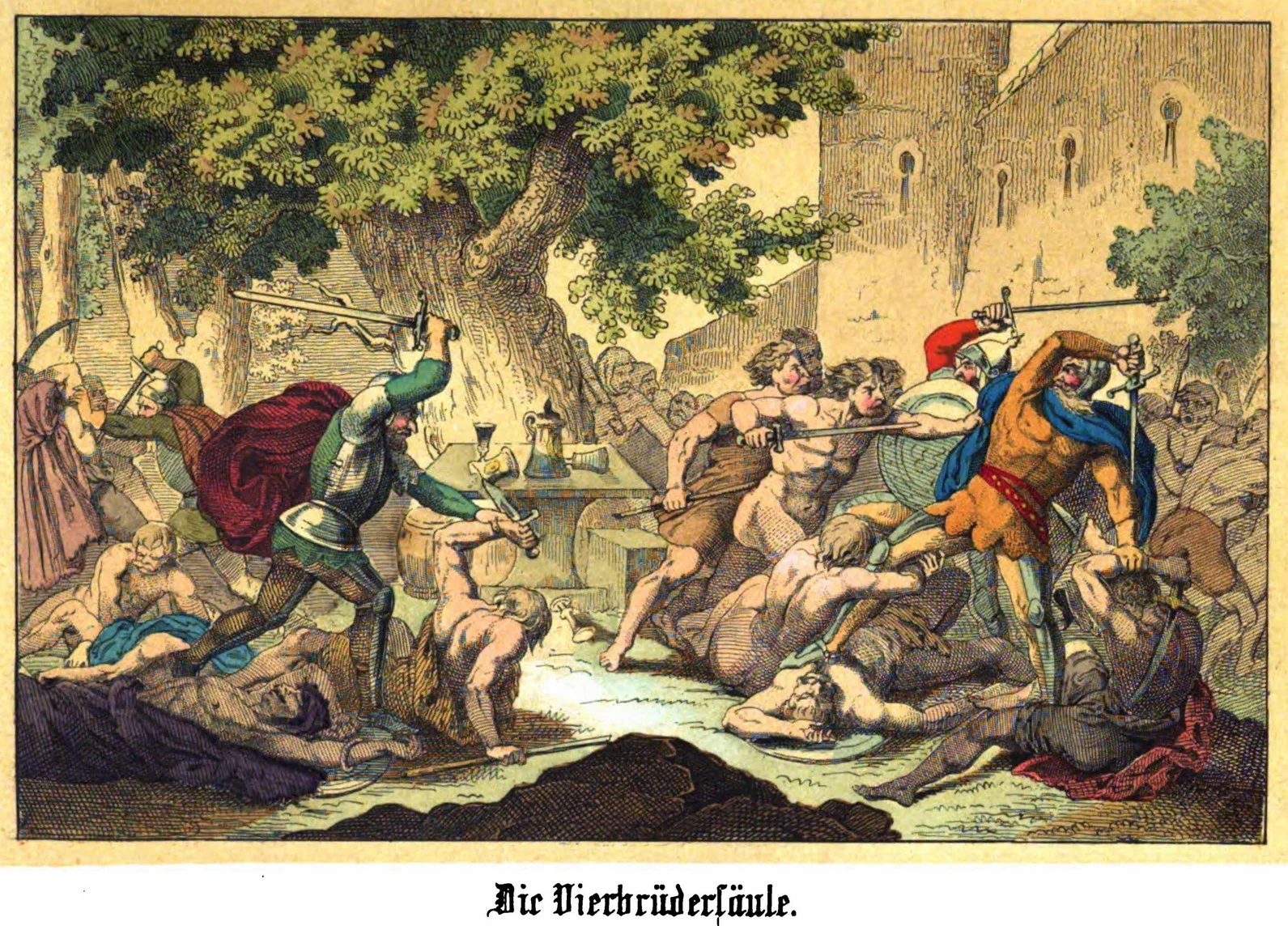
The anonymous writer “M. R.” makes Golin a young citizen of Kulm whose sister is sacrificed by the pagan Prussians. He escapes with superhuman violence, becomes a knight and joins Hans Robezoll, Conrad Stobemehl and Klaus Diewel.
The four storm the strong castle Konoweidit; the Landmeister grants it to Golin and his descendants; and it becomes their raiding base. In 1295 three companions are killed while feasting outside the castle. Golin buries them, keeps silent watch for two weeks and dies beside the grave. The Landmeister then erects the four-headed column.
This is excellent evidence for nineteenth-century popular reception, but almost none of its distinctive detail can be used as independent medieval history. A full translation belongs more naturally on a future Vierbrüdersäule page.
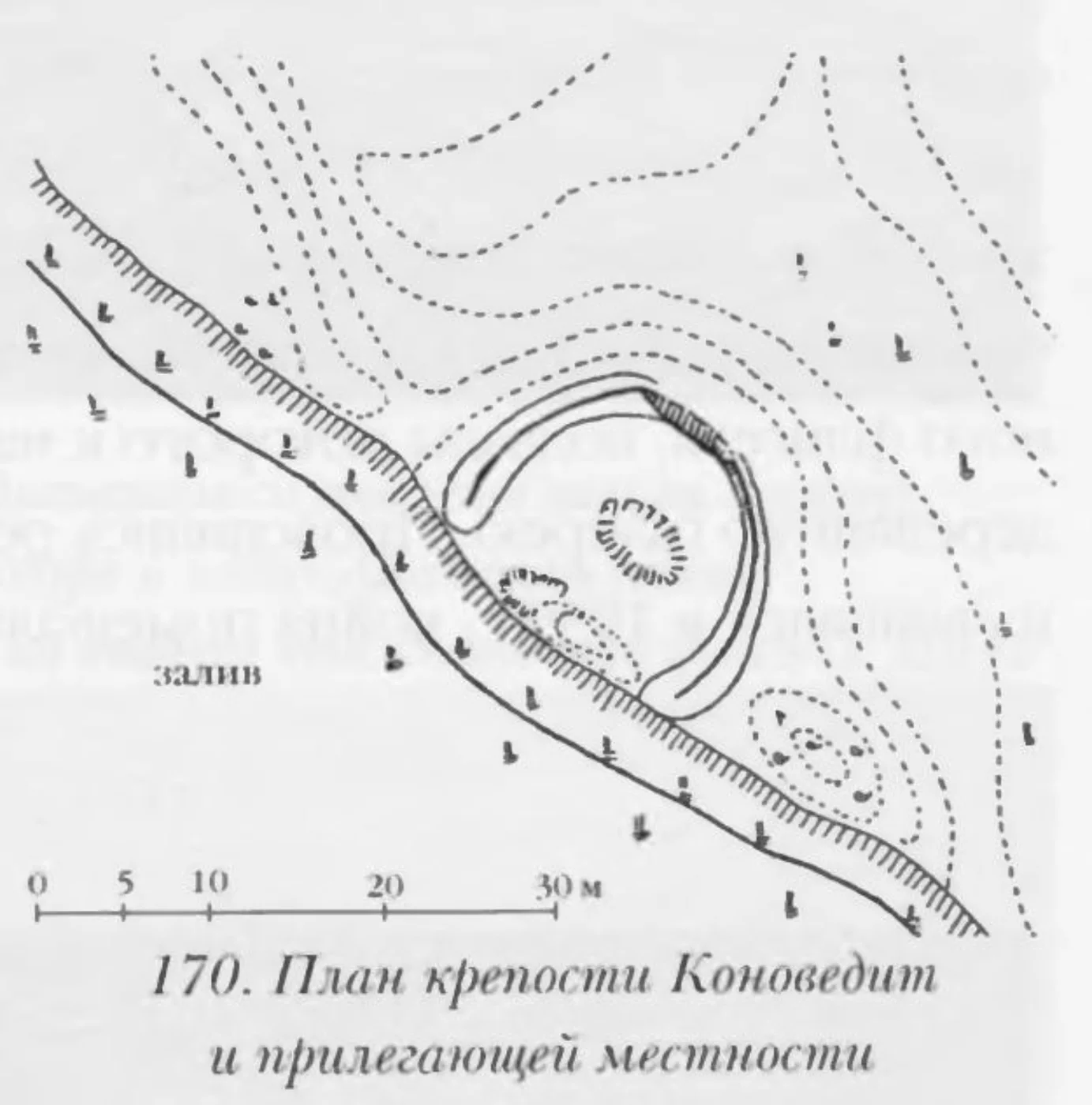
A. P. Bakhtin’s modern survey accepts the traditional identification of Dusburg’s unnamed castle as Conowedit and reproduces a redrawn version of Crome’s plan. Its notes show that the physical account comes through Crome, not a new Russian excavation.
A. B. Gubin and V. N. Strokin detach the four brothers from Conowedit altogether: they become anonymous knights from Wargen killed by Sudovians. Elsewhere the same authors conflate Kaporn, Conowedit, Wargen, the Vierbrüdersäule and supposed sixteenth-century maps while admitting that the information is confused.
These works are useful for modern regional reception and some local geography. They do not strengthen the medieval identification independently.
Legendary sequence
The legend remains historically valuable—not as a transparent record of 1295, but as evidence of how places, monuments and printed stories acquired meaning over four centuries.