Supports
The event, broad geography, Steynow’s role and the Glappenberg tradition.
Textual tradition
The earliest accounts give us a castle but no name. A late-fifteenth-century Utrecht chronicle explicitly supplies Cenauwe; later witnesses vary, and the name is only afterwards attached securely to the Caporn landscape.
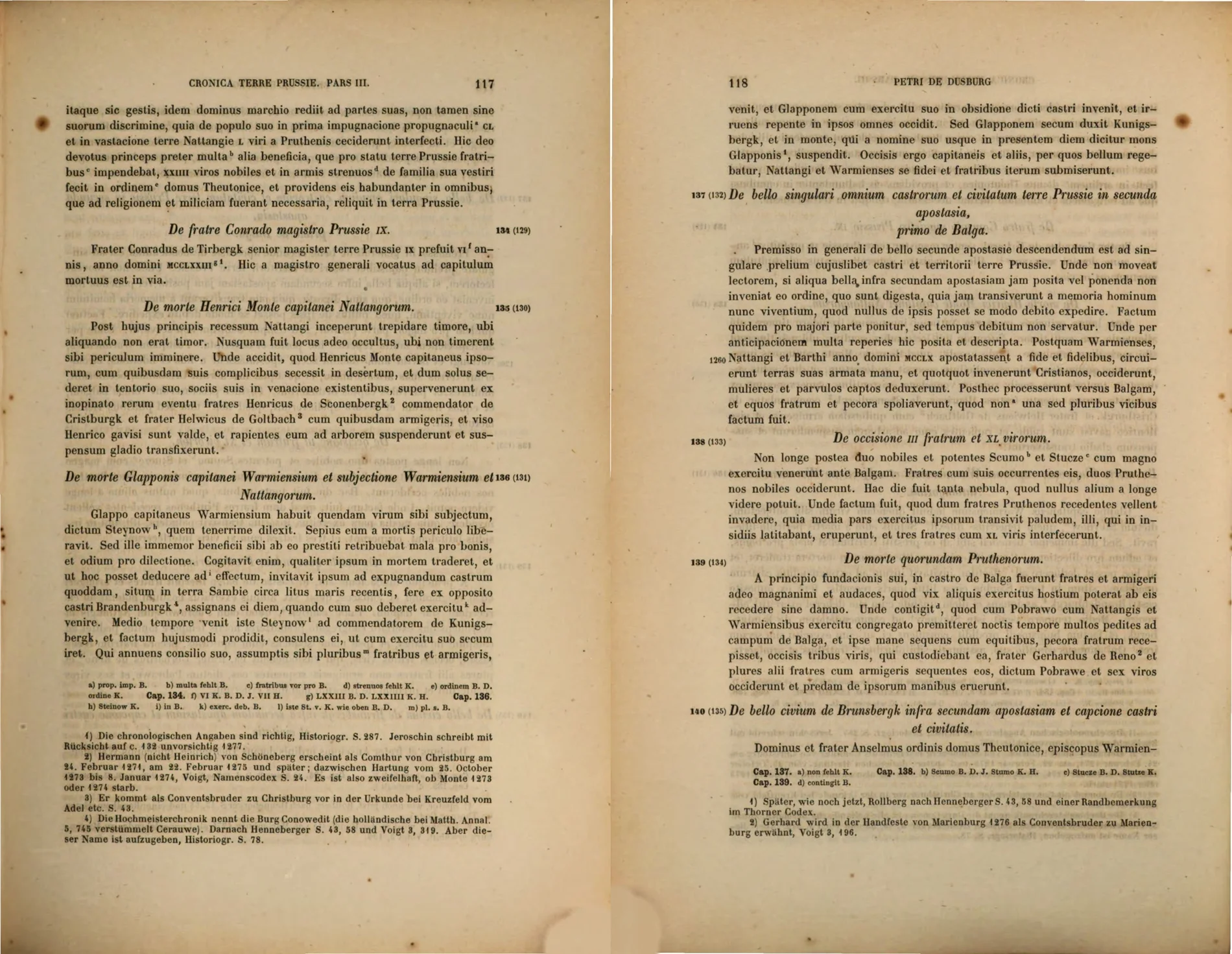
Peter of Dusburg says that Glappo was induced by Steynow to attack a castle in Samland, close to the shore of the Haff and approximately opposite Brandenburg. Steynow betrays him; an Order force surprises the attackers; Glappo is carried to Königsberg and hanged.
The event, broad geography, Steynow’s role and the Glappenberg tradition.
The castle’s name, an exact location near Caporn, its architectural form or any connection with Martin Golin.
Nikolaus von Jeroschin’s Middle High German verse retelling follows the episode without supplying a castle-name.
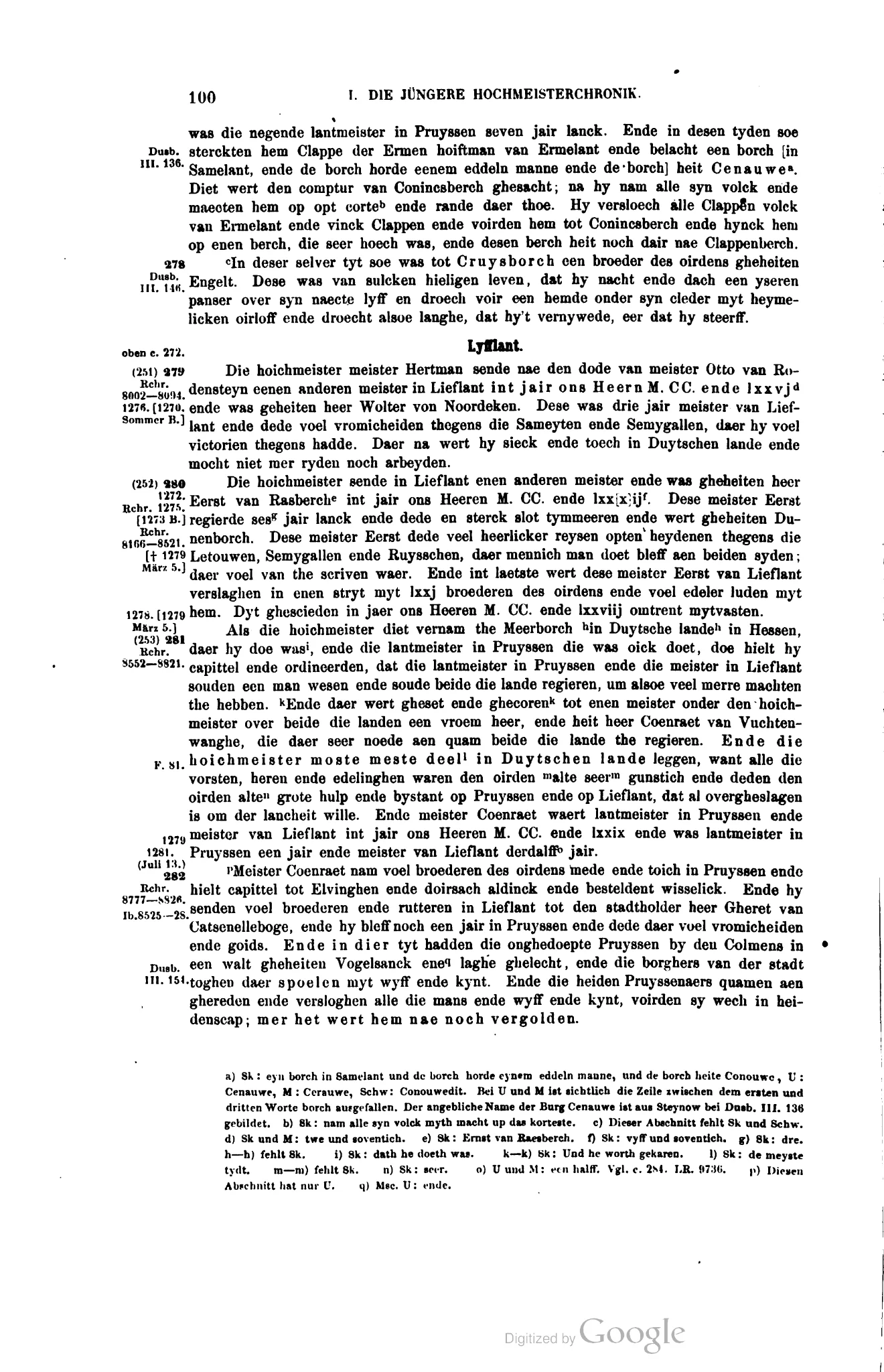
Modern work by Rombert Stapel materially sharpens the problem. The text long known in German scholarship as the Jüngere Hochmeisterchronik is a late-fifteenth-century Middle Dutch history now usually called the Utrecht Chronicle of the Teutonic Order. Stapel identifies Vienna, Deutschordenszentralarchiv Hs. 392 as an “author’s copy”, written in direct cooperation with the original author.
ende dese borch hiet Cenauwe — “and this castle was called Cenauwe”.
This means that the basic form Cenauwe was present at or very near the chronicle’s composition, not merely introduced by a much later copyist. Hirsch’s nineteenth-century apparatus remains valuable because later witnesses preserve related forms including Conouwe, Cerauwe and Conouwedit.
“The alleged name of the castle Cenauwe was formed from Steynow in Dusburg III.136.”
Hirsch’s derivation remains plausible, but its mechanism is less simple than a late scribal typo. The Utrecht compiler had access to a wide range of Order historiography. We do not yet know whether he derived Cenauwe by misunderstanding an older text, inherited it from an intermediate source or gloss, or possessed some independent piece of information.
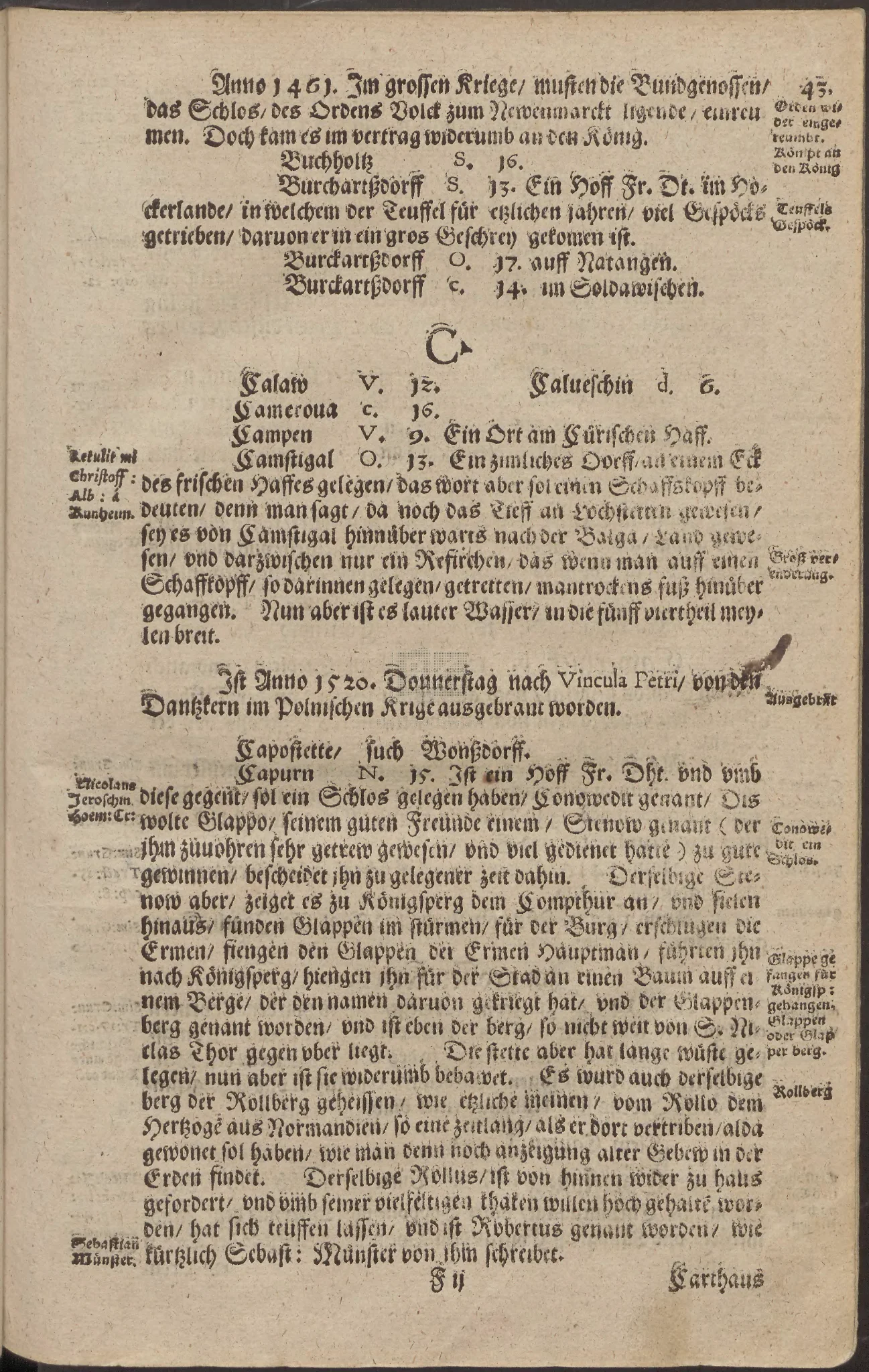
Hennenberger says that in the Capurn district a castle called Conowedit was said to have stood. A separate alphabetical entry repeats the story and points the reader back to Capurn.
His wording—sol ein Schloß gelegen haben, “a castle is said to have stood”—is cautious. He transmits an identification rather than describing a visible castle.
By 1595 the name Conowedit was attached to the Capurn region and to Glappo’s episode.
Whether this came from local knowledge, the unstable chronicle text, another map or Hennenberger’s own reasoning.
His 1576 map marks Capurn but no separate Conowedit. At its scale, that absence is not decisive.
Johannes Voigt explicitly notes that the chroniclers do not securely name the castle. He nevertheless concludes that Dusburg’s geographical description “clearly points to Konowedit”, because Hennenberger places it near Caporn, opposite Brandenburg.
The reasoning is plausible if Hennenberger preserved independent geographical tradition. It is circular if Hennenberger himself derived the Capurn location by combining Dusburg’s geography with the later castle-name.
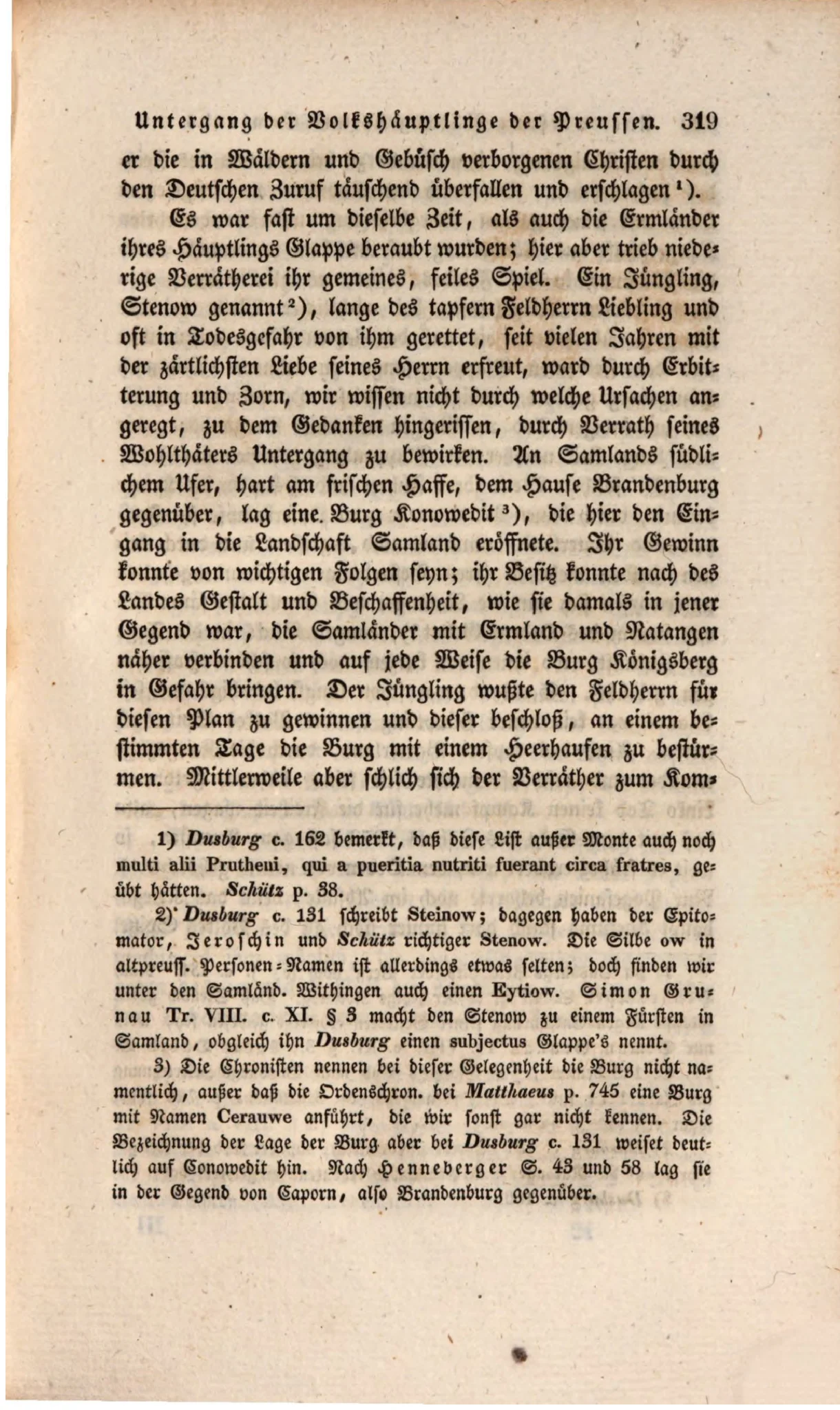
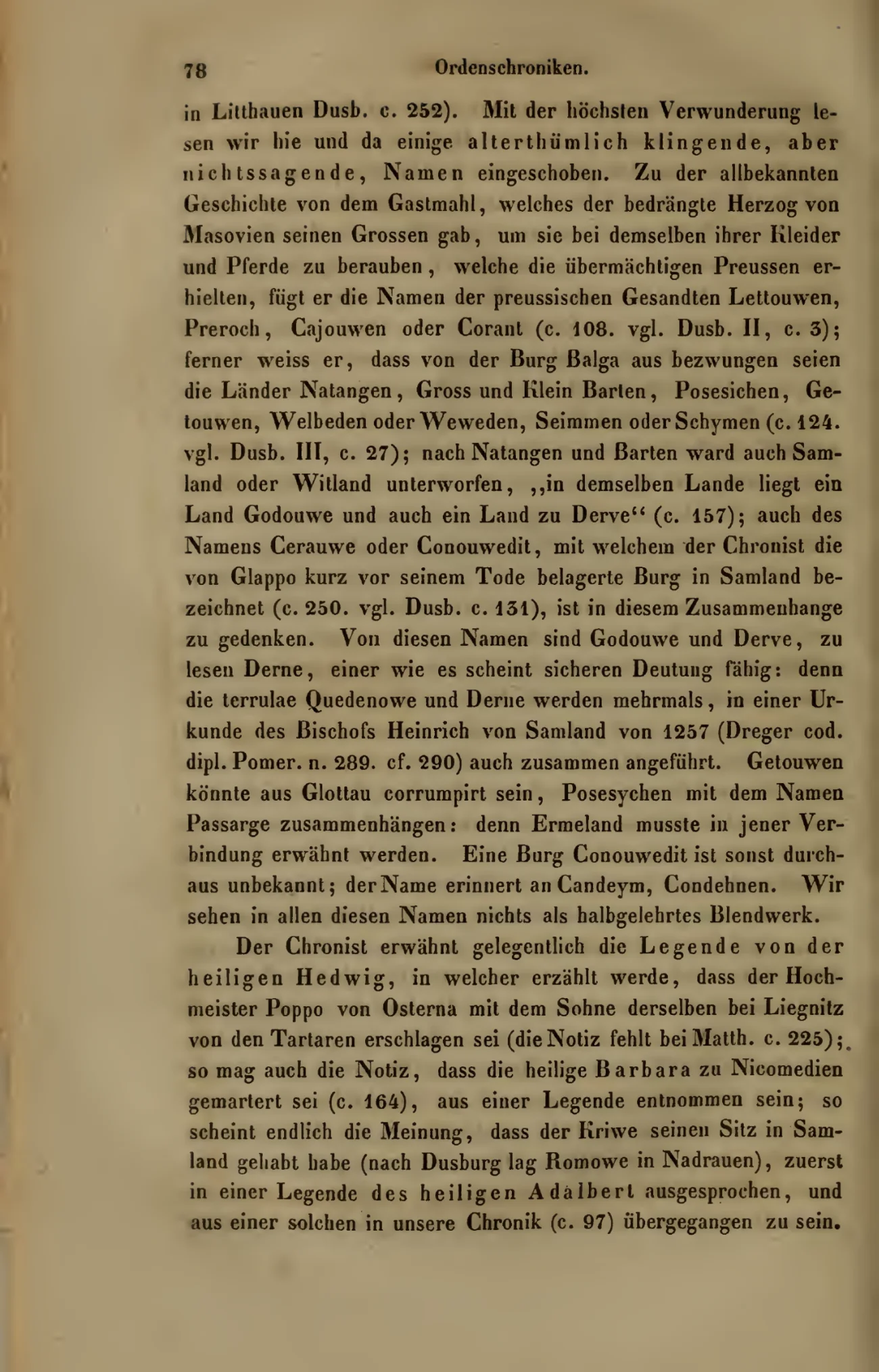
Töppen calls Conouwedit and comparable antiquarian-sounding names halbgelehrtes Blendwerk—pseudo-learned or half-learned embellishment—and says that such a castle is otherwise entirely unknown. Hirsch’s specific proposal derives Cenauwe from Dusburg’s personal name Steynow.
This criticism strongly weakens the claim that Connowedit was the secure medieval name of Dusburg’s castle. It does not disprove the Margen earthwork, nor does it prevent a later local tradition from attaching the name to it.
Textual conclusion
The safest account therefore distinguishes three propositions: Dusburg’s castle is unnamed; Cenauwe is securely attested in the late-fifteenth-century Utrecht Chronicle; and the identification of that textual castle-name with the Margen earthwork remains a later historical argument rather than a demonstrated fact.